

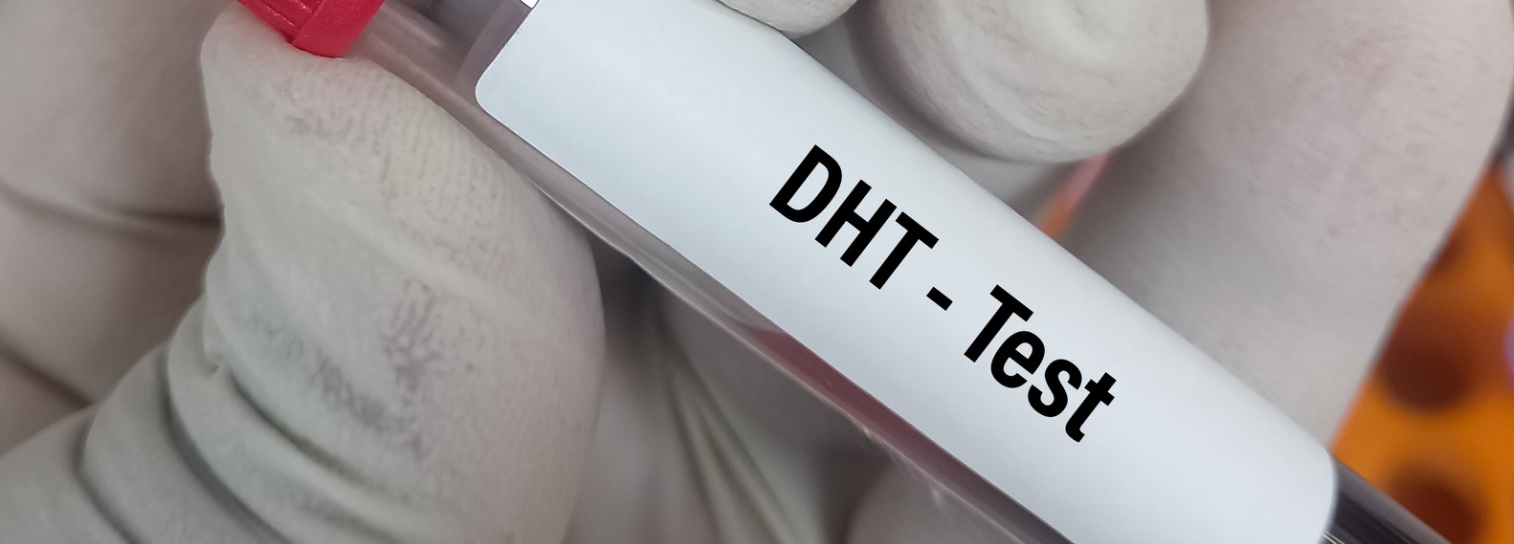
What Hair Clinics Don’t Always Explain About DHT Suppression
DHT plays a major role in male pattern hair loss, which is why treatments such as finasteride feature so heavily in clinic consultations. But reducing DHT is only one part of a much bigger picture — and there are several things worth understanding before viewing hormone suppression as the whole solution.
Why does every hair-loss conversation seem to come back to DHT?
There is a good reason. Male pattern hair loss, or androgenetic alopecia, is strongly influenced by genetics and by the way susceptible hair follicles respond to dihydrotestosterone (DHT).
In affected follicles, DHT contributes to progressive miniaturisation. Over time, individual hairs become shorter, finer and less visible.
That makes DHT an obvious therapeutic target — and explains why medications that reduce DHT production can be effective.
Where the conversation can become too simplistic is when DHT is treated as though it is the only thing that matters.
Genetic sensitivity, age, follicle miniaturisation, scalp condition, nutrition, general health and the stage of hair loss all influence what someone ultimately sees in the mirror.
What DHT actually does to susceptible hair follicles
Follicle miniaturisation
Genetically susceptible follicles gradually produce thinner and shorter hairs under androgen influence.
Shorter growth cycles
The active growth phase can become progressively shorter, giving hairs less time to grow before they shed.
Visible density declines
As more follicles miniaturise, the scalp gradually becomes more visible through the hair.
Progression varies
Genetics determine how sensitive follicles are, which is why some men lose hair rapidly while others progress very slowly.
DHT itself is not a biological mistake
DHT is a naturally occurring androgen produced from testosterone by the enzyme 5-alpha-reductase.
It plays physiological roles in androgen-sensitive tissues. The problem in male pattern hair loss is not simply that DHT exists; it is that genetically susceptible scalp follicles respond to it in a way that promotes miniaturisation.
That distinction matters. Treatments are not attempting to correct an abnormal hormone that should never have been there. They are modifying an androgen pathway in order to reduce its effect on vulnerable scalp follicles.
What finasteride actually does
Finasteride inhibits type II 5-alpha-reductase, reducing the conversion of testosterone into DHT.
In men with androgenetic alopecia, this reduction can slow further hair loss and, in some users, improve visible hair growth or density.
It is one of the most established medical treatments for male pattern hair loss and has been studied over several years of continuous use.
What long-term treatment can do
- Slow the progression of male pattern hair loss.
- Help preserve existing scalp hair.
- Produce visible improvement in some men.
- Maintain benefit for years in responsive users.
- Delay further miniaturisation while treatment continues.
What may receive less attention during a consultation
Treatment usually means long-term treatment
Finasteride does not permanently switch off male pattern hair loss. Its benefits generally depend on continuing treatment.
If treatment is stopped, the protective effect diminishes and genetic hair loss can begin progressing again.
Maintenance can still be a successful result
Hair-loss treatment is often judged by how much new hair appears. That can create unrealistic expectations.
With progressive androgenetic alopecia, simply preventing the amount of hair you would otherwise have lost can represent a meaningful treatment benefit.
Not everyone responds equally
Genetics, age, severity of hair loss and how long follicles have been miniaturising can all influence the response.
Someone in the early stages of thinning may have very different potential from someone with long-established bald areas.
Side effects deserve a proper conversation
Finasteride is well tolerated by many men, but recognised adverse effects include reduced libido and erectile problems in a minority of users.
Anyone considering prescription treatment should understand both the potential benefits and potential risks rather than viewing it as an automatic decision.
DHT reduction cannot fix every cause of shedding
A man taking finasteride can still experience hair loss or shedding for reasons unrelated to androgenetic alopecia.
Illness, significant calorie restriction, nutritional deficiencies, medication, stress-related telogen effluvium and scalp disease can all influence the hair cycle independently of DHT.
The treatment decision is about benefit versus trade-off
The useful question is not whether DHT is “good” or “bad”. It is whether reducing DHT is an appropriate treatment strategy for the individual in front of you.
Potential benefits
For appropriate men with androgenetic alopecia, DHT suppression can provide one of the strongest evidence-based ways of slowing further progression.
Men who respond well may retain substantially more hair over the long term than they would have without treatment.
Points to consider
Treatment generally needs to continue indefinitely to maintain the benefit, and prescription medication can produce side effects in some users.
That makes informed choice and realistic expectations important.
Why do some people feel their results have “plateaued”?
This is a common source of confusion.
A man may see a noticeable improvement during the first year or two, followed by a period where his hair appears relatively unchanged.
A plateau does not automatically mean treatment has stopped working.
Androgenetic alopecia is progressive. Once an early improvement has occurred, maintaining approximately the same amount of hair over the following years may itself represent continued treatment success.
Without treatment, the same person might otherwise have experienced considerably more miniaturisation and visible loss.
Blood DHT is not a hair-growth score
Another useful distinction is that measuring circulating DHT does not tell you exactly how much hair someone will retain.
Hair loss depends on the sensitivity of individual follicles to androgens, genetic predisposition and the stage of miniaturisation. Two men with similar circulating hormone levels can therefore have very different hair-loss patterns.
This is one reason visual assessment, photographic monitoring and the pattern of progression are often more useful than focusing on a single hormone number.
Good hair management still needs a wider foundation
DHT suppression can target an important mechanism in androgenetic alopecia, but it does not remove the need to look after the hair and scalp more broadly.
Adequate protein and micronutrients
Hair still requires sufficient energy, amino acids, vitamins and minerals to grow normally.
Maintain scalp health
Treating irritation, dandruff or other scalp problems can help keep the environment around existing hair healthier.
Track the trend, not the day
Standardised photographs over several months are much more useful than inspecting the hairline every morning.
Give treatments time
Hair cycles are slow. Established treatments and supportive routines generally need months before they can be assessed fairly.
DHT suppression is powerful — but it isn't the whole story
DHT is one of the central drivers of male pattern hair loss, and reducing its activity can be an effective long-term strategy for many men.
The missing part of the conversation is often less dramatic: treatment may need to continue for years, maintenance can be a successful outcome, not every man responds equally, and other causes of shedding can still occur at the same time.
The best approach is therefore not to demonise DHT or dismiss DHT suppression. It is to understand exactly what the treatment can do, what it cannot do, and where it fits within a broader long-term hair-loss strategy.
Support your hair beyond a single pathway
HR23+® provides broad daily nutritional hair support with 23 carefully selected vitamins, minerals and botanical ingredients. It can be used as part of a wider hair-care routine alongside other appropriate approaches.
Explore HR23+®This article is for general information only and should not be considered medical advice. Finasteride and other prescription hair-loss treatments may not be suitable for everyone. Discuss potential benefits, risks and side effects with an appropriately qualified healthcare professional before starting or stopping prescription treatment.