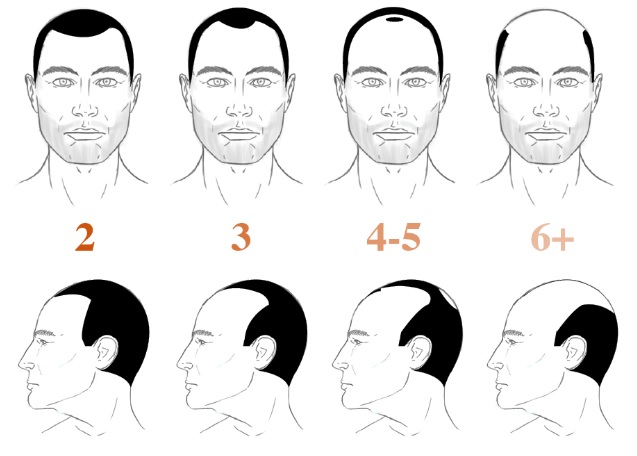
Norwood–Hamilton Scale for Hair Loss
Understand each Norwood stage of male pattern baldness, how to recognise your level, and which treatment options are typically considered at each stage.
The Norwood–Hamilton Scale is a widely used classification system that describes how male pattern baldness (androgenetic alopecia) progresses. Stages 1–4 are generally considered early; above stage 4 is more advanced and harder to treat conservatively.
While the scale is not a medical diagnosis, it’s a helpful guide to set expectations and build a realistic plan. Identifying your stage early usually gives you more options.
Is It Too Late to Treat Hair Loss?
Not necessarily. The scale offers a useful snapshot of where you are and helps you choose appropriate options. Earlier stages typically respond better to non-surgical approaches; later stages often need a different strategy and expectations.
Norwood Stages 1–2
Mild recession at the temples and, in some men, subtle thinning at the crown. Many remain stable for years with the right routine.
- Focus: early intervention and scalp/follicle support.
- Common tools: topical agents (e.g., minoxidil), supportive shampoos (e.g., ketoconazole), scalp serums (e.g., KGF-based), lifestyle optimisation, and targeted supplementation.
- Goal: slow shedding, maintain density, and support thicker-looking growth.
Drug-free support such as HR23+ can be a useful foundation for early stages. See also: What is DHT?
Norwood Stages 3–4
More pronounced temple recession and a visible crown thin/bald patch. This is still considered relatively early but requires consistency and realistic expectations.
- Focus: stabilisation and visible improvement where possible.
- Common tools: topical minoxidil, prescription options (where appropriate), supportive serums/shampoos, microneedling/LLLT, and nutritional support (e.g., HR23+).
- Goal: reduce further loss and thicken existing hair. Some regrowth may be achievable with diligent routines.
Many men in this range see the best results from a combined plan rather than a single product. Explore: Treatment options for hair loss.
Norwood Stage 5 and Above
Extensive recession with a larger bald area at the crown; the bridge of hair between them is thinning or gone. At this point, non-surgical approaches may offer limited cosmetic benefit.
- Focus: realistic goals and long-term maintenance.
- Common tools: consultation for hair transplantation, camouflage strategies (cuts, fibres), and scalp health maintenance.
- Note: drug-free supplements (including HR23+) are unlikely to deliver strong visible changes once loss is this advanced, though they may support scalp/hair quality.
Drug-Free Support for Early Stages
For Norwood 1–4, many men incorporate nutritional support into their routine. HR23+ is a premium, drug-free supplement designed to help reduce shedding and support stronger, fuller-looking hair when used consistently.
How to Use the Norwood Scale
- Match your current pattern to the closest stage in the diagram.
- Set expectations: earlier stages respond best to conservative care.
- Create a plan you can follow for 3–6 months before judging results.
- Consider a consultation with a GP, dermatologist, or trichologist to tailor your approach.